

Milan Kundera passed away two weeks ago. He was 94 years old. I was bothered by the lack of media coverage (only one short article on both the BBC and the Guardian), so I decided to dedicate this post to him – but I wasn’t sure what I was going to write about. Until I bought two of his novels and saw the covers, that is. Want to know what I noticed? Read on!
I often call Milan Kundera one of my favourite novelists. This should come as no surprise, since Kundera often stated that the novel is the highest form of art, and as a literature lover, I can only agree. The thing is, I have read only two of his novels so far (The Unbearable Lightness of Being and Immortality, both of which I’ve written about here on my blog), so does that make me a faker? Does that make me a snob because it makes me sound interesting? Or do I simply really love his work, his style, and his philosophical ideas? I like to think it’s the latter.
Whenever I’m in a second-hand bookstore and I see a Kundera novel I haven’t got yet, I buy it (the second-handedness doesn’t really matter; it’s more that the English-language department of my bookshop doesn’t always have his novels in stock). I think I have seven of his novels now, ranging from new to quite old. The older books feature a rather old picture of him, and the newer books have a newer picture – of him as al older man (funny how the words old and new work, isn’t it?). But there’s something strange about this newer picture.
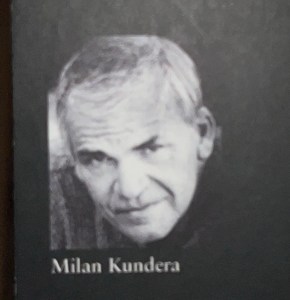
The picture itself is not the issue. What struck me as interesting, and actually quite Kunderian, is that this same picture is copyrighted by three different people: Vera Kundera, Fridrik Rafusson, and yet another person altogether. This is strange, and it got me thinking.
Identity is one of the most important themes in Kundera’s work, and especially how one’s identity is quite fluid. Does this mean, then, that Milan Kundera, even if it’s the same picture, is a different person with every book he’s written? And does that mean that different people are allowed to claim that they are the proper copyright holders of said photograph, even if it’s the same one?


So, if one’s identity is fluid, and we’re never the exact same person, then Kundera’s entire oeuvre has immediately become so much more interesting. Imagine what it would be like if I were to reread all of his books: I would be a completely different person from the one I was when I read his novels the first time around. And my opinion and impression of him and his books would keep changing, too. I should devote myself to reading his novels at least once a year. Imagine how much we’d change!
I started reading his novel Farewell Waltz a couple of days ago. I haven’t finished it, not even close. But it turns out that whatever Kundera writes, or whatever picture of him is taken, he makes me think. It’s how he would have wanted it.
Rest in peace, Milan Kundera.
What is your favourite Kundera novel? Do you ever think about who you are and what you’re supposed to be for others? Do you think our identities are really fluid? Please share in the comments! Also, don’t forget to follow me for more bookish posts!

 The Open Book