
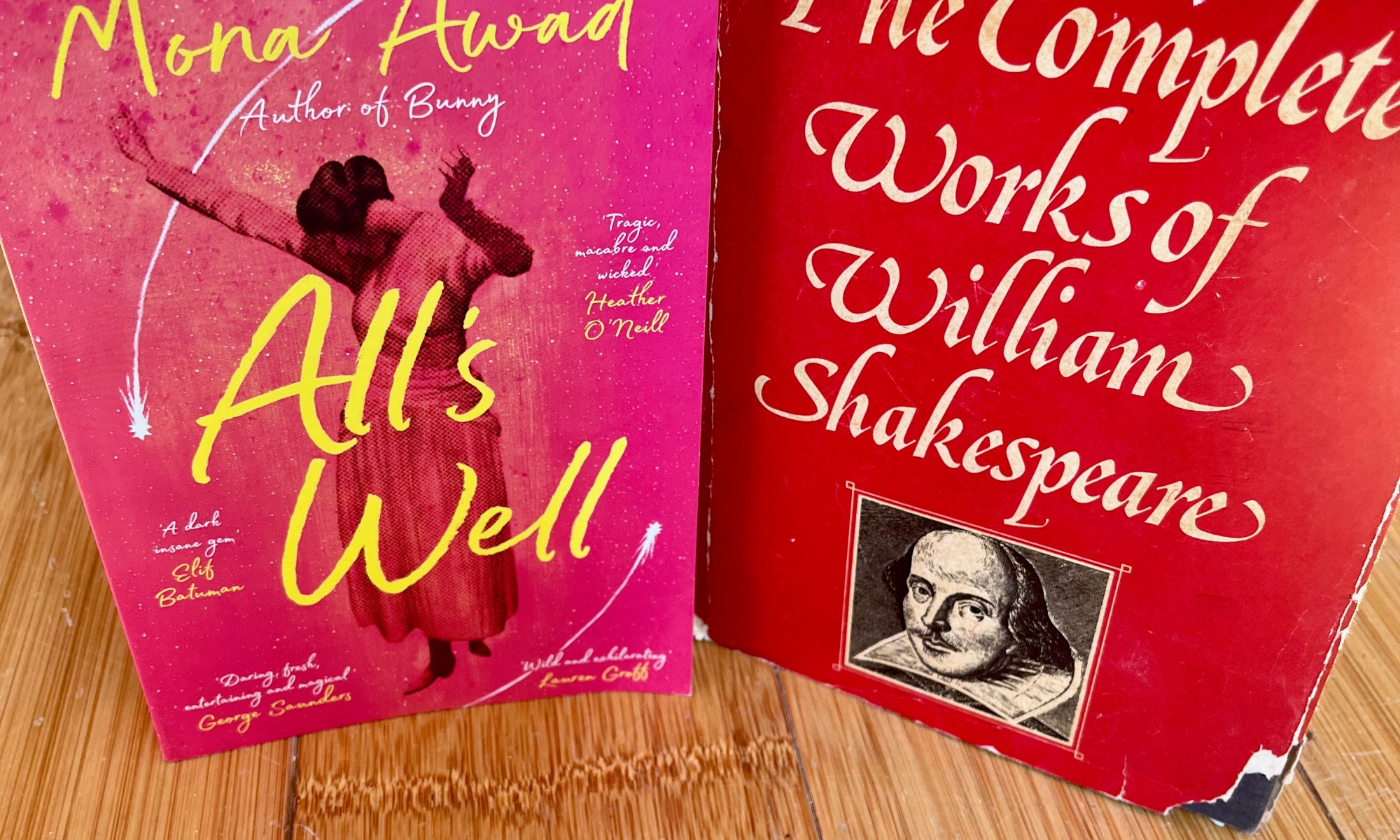

I like to think of myself as a person who doesn’t judge a book by its title. Usually, I look at who’s written it and at the premise, and sometimes even its cover. However, I recently walked into a bookshop (as I occasionally do) and I stumbled upon Mona Awad’s novel All’s Well, and it reminded me of Shakespeare – and therefore I had to buy it. Want to know whether it really is about Shakespeare, and if the title makes sense? Read on!
Mona Awad’s novel All’s Well is about college theatre director Miranda Fitch, whose acting career came to a sudden end when she fell off the stage during a performance of Shakespeare’s play All’s Well That Ends Well, which left her with chronic back pain and an addiction to pain medication. She is determined to put on that same play with her students – one of whom, Ellie she likes and one of whom, Briana, she can’t stand – but they don’t like it, or her, very much. It is only with the help of three strangers that she might be able to come up with a solution.
Of course I only bought this book because of its title. I expected some kind of retelling of Shakespeare’s All’s Well That Ends Well, a play I vaguely know. In short, it’s about Helena, who is in love with Bertram who doesn’t reciprocate her love. Heartbroken, she travels to France to heal the King, who promises her to marry anyone she likes, meaning Bertram. He refuses to marry her and leaves. She then deceives him, fakes her own death, and in the end, he suddenly does love her. Critics have been divided on this final, almost magical ending, because to some it feels quite artificial.

When I started reading Awad’s novel All’s Well, I realised it makes sense as a title because it loosely mirrors the events in the original play. Miranda (a reference to another Shakespeare play, The Tempest, by the way) is determined to stage All’s Well That Ends Well because her performance as Helena made her husband fall in love with her, and it was the play that both started and ended her professional career as an artist, because her fall off the stage meant she could not move without pain anymore. This means that Miranda is less like Helena and more like the King, who is mortally ill and needs a miracle.
In All’s Well, the miracle is three strangers who are very similar to the three witches in Shakespeare’s play Macbeth. The novel should have been called All’s Well/Macbeth, because it heavily features elements from the latter play; when she meets the Three Brethren, she soon feels better, prettier, sexier, and more confident. She soon realises, however, that with the diminishing of her pain, others become ill. She doesn’t care too much, though, although she does feel like she is losing sense of reality.
When it comes to reality, the title of Awad’s novel doesn’t only refer to Shakespeare; according to the blurb, it is an “indictment of our collective refusal to witness and believe female pain”. Over the years, it has become increasingly clear that doctors have failed to acknowledge women’s complaints of physical discomfort. Therefore, ‘all is well’is the common response women have when they are asked how they are doing, because they will not be taken seriously anyway. Awad’s novel is told from Miranda’s perspective, which allows readers to understand just how hard it is to explain how immobilising pain can be. Miranda, therefore, represents all those women whose doctors failed to believe them. However, there’s a problem: Miranda’s pain is so bad she can’t do anything. So how could this novel reach its “ends well” conclusion?

And here lies the real problem with All’s Well: while it is trying to give a voice to all those women who found themselves not taken seriously about their pains, Awad seems equally unable to give them the serious attention they deserve, and the plot is only moved forward because of a magical interference. Furthermore, Miranda soon starts going mad, in much the same way Macbeth does in Shakespeare’s eponymous tragedy. I started wondering whether everything Miranda goes through after she has been miraculously healed was some sort of fever dream.
In conclusion, calling a novel All’s Well is tricky. It could refer to Shakespeare, and it could be a comment on our society which does not allow us to talk about suffering. Miranda is supposed to be a representation of all those women who were sent home by doctors after complaining about their physical pain. However, this play doesn’t mirror Shakespeare’s problem play, but rather the tragedy Macbeth, whose protagonist ends up mad and dead. So what should you call a novel in which nothing is well, and nothing ends well?
Well…
What did you think of All’s Well? Do you think we should talk more about pain and what it can do to us? Why do you think Awad used Shakespeare in her novel? Do you know any other novels that were inspired by Shakespeare? Please let me know in the comments! Also, don’t forget to follow me for more book-related posts!

 The Open Book