

Oxford, the city of spires, the city of knowledge, the city of enormous wealth. Which tourist would not be impressed by it? I know I was. What I was not concerned with at all, however, was how Oxford had become such a magnificent city. Thankfully there’s R.F. Kuang’s fantasy novel Babel about Oxford’s translation guild, which shows the dark, colonial past of the city. Want to know what it’s about and what it stands for? Read on!
Babel is about Robin Swift, a boy from Canton who is looked after by an Englishman after his entire family dies. Robin Swift, by the way, is an anglicised name, and we never learn his original name. He is training to be a translator, which means he is allowed to work with Great Britain’s most valuable resource: silver, which, when the right words are used, possesses magical powers. Robin, feeling the privilege of receiving such a treasured education, is loyal to Oxford. However, when he realises that his knowledge is used for Oxford’s own gain and that his people are being oppressed, he and his friends decide to rebel.
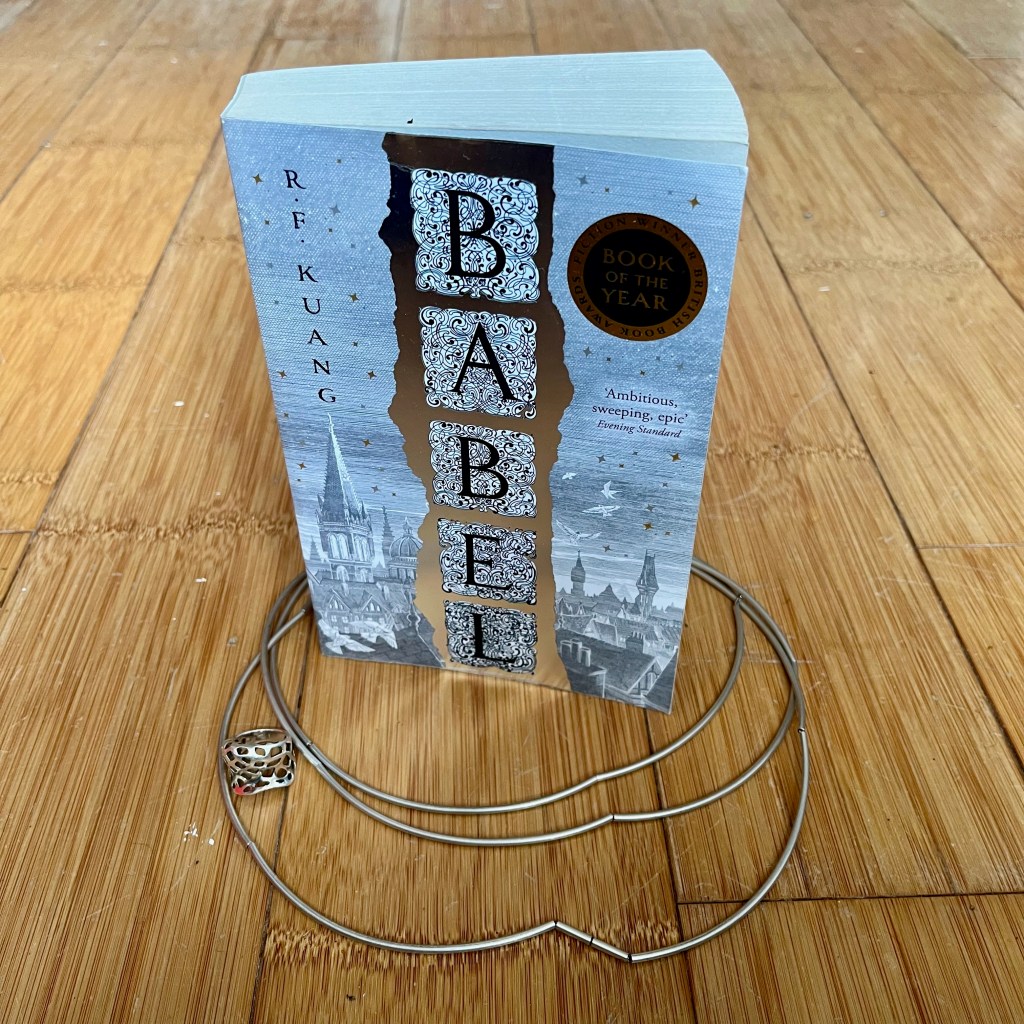
Babel is a novel with many important themes: colonialism, abuse of power, discrimination and deceit on one side, and friendship, loyalty and justice on the other. Kuang is one of the few fantasy authors who focus on China and how Chinese characters deal with the West. Babel is a prime example of this, because the Cantonese Robin slowly but surely realises that he is being used and that nobody really cares about him as a person.
While Kuang’s novel belongs to the fantasy genre because of the magic in it, Babel is definitely based on real events. Kuang wants to show that the West, in this case the UK, has only become rich through colonialism and oppression. In Babel’s case, the oppressors did not only take money and resources, but even use languages for their own gain.
To be honest, I felt quite guilty while reading this book. I am a Western woman and hardly aware of our history (the Netherlands, of course, is not innocent either, with its colonial past and its so-called Golden Age). While reading, I realised I should be more aware of the country I live in and the dark parts of its past. Babel showed how nothing is exactly what it appears and how we should be aware of this. The downside of this novel is that it didn’t just show it; it often hammered home its message. And sometimes, that was too much of a good thing.
The thing about Babel is that it’s a novel which appears to have it all: it’s exciting, it’s timely, and it’s very intelligent (history, etymology; Kuang has thought of it all). It’s even an important book, because it is about a taboo subject which many of us hardly ever think about. Unfortunately, sometimes it read more as a manifesto against colonialism than a novel, and it regularly made me sigh in frustration. The characters all talked in the same (preachy) way and sometimes made decisions that felt quite forced. I have no problem whatsoever with the magical qualities of silver and how it keeps the entire British economy running, but it is the characters that simply lack credibility. I think that’s because Kuang, a Chinese-American author, put much of her own identity into her novel. And that brings us to what it was like to be in Oxford after reading Babel.
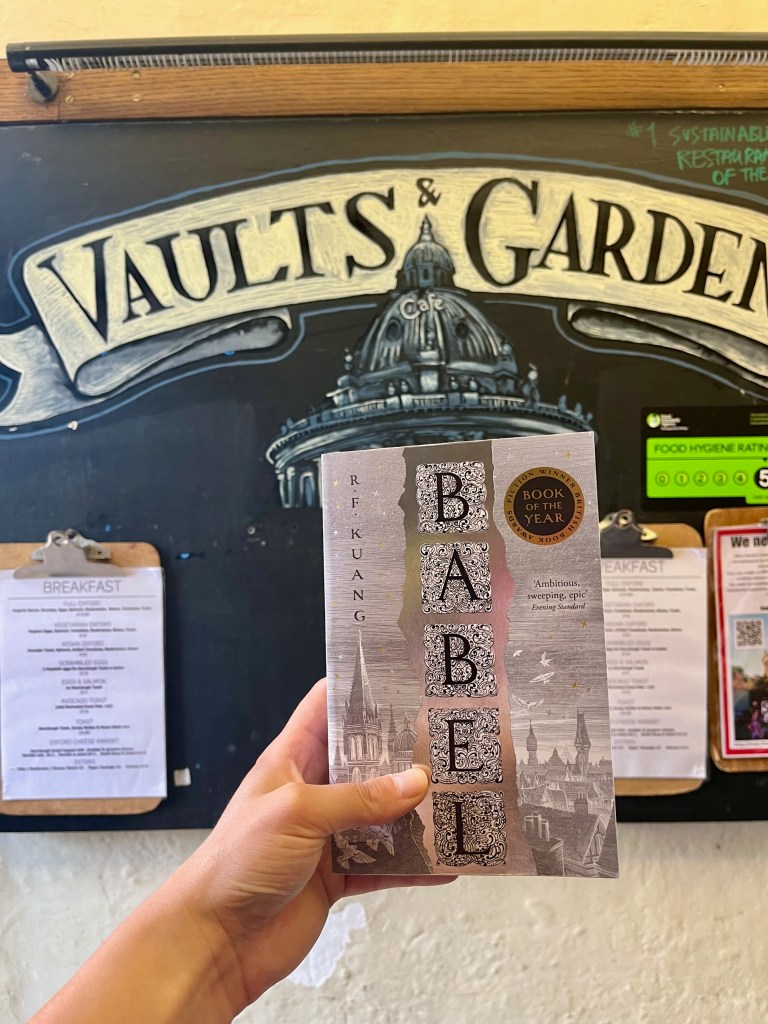
In its introduction, Kuang writes that she has tried her best to describe nineteenth-century as authentically as possible, but that she did use some poetic license. One of them, she says, is the Vaults & Garden café in Oxford, because she loved its food and wanted her characters to enjoy it, too. However, she draws so much attention to it in this introduction, that every mention of it in Babel made me realise it’s only a novel, thus breaking my suspension of disbelieve. In fact, when I was in Oxford, I was more excited about eating there than diving into the novel’s message. I don’t think that’s quite what Kuang intended with her novel.
After we’d had lunch at Vaults & Garden (and my vegan Oxford breakfast with avocado and beans really was quite good; but please note how much time I’ve already spent on such a silly detail), I realised that I was in the right mindset. While walking through Oxford, I took a good look at all the buildings and colleges and statues, and I kept thinking how all these colleges used to be inhabited solely by white men, and the statues were mostly depicting white men. However, that’s when it hit me that the buildings were definitely not made by white men, but that it was quite possibly migrants who built them. I don’t think many people realise this. And raising this awareness must be exactly what Kuang intended with Babel.
While walking there, amongst all that beauty and wealth, I realised I started feeling guilty again. I was still mesmerised by Oxford, but I knew, just like Robin Swift in Babel, that something was off. I could cancel this city, I thought, and could tell my parents (whom I dragged around to all those literary places that I wanted to visit – thank you for putting up with me!) that I was done with this city and go home and write a harsh blog post about Oxford. Or, alternatively, I could add a layer to my knowledge and enjoy this city, knowing that it has a problematic past, but knowing, also, that we are slowly moving towards a more just, and a more inclusive world – a world in which everyone is equal and where history keeps being rewritten – which is exactly like Kuang did.
Obviously, I chose the latter.
What did you think of Babel? Do you think there is enough representation of non-Western persons in famous cities like Oxford? Do you ever think about how wealth is divided in our world? Do you ever try to do anything about inequality? Please let me know in the comments! Also, don’t forget to follow me for more bookish posts!

Next up in the Oxford trilogy: La Belle Sauvage by Philip Pullman.
 The Open Book