


Do you ever feel like you want to live a different life? And what if you could change everything, but would never be able to return to your old life? I recently read Brooklyn by Colm Tóibín, which is about a young girl who leaves her dreary old town in Ireland for an unknown future in America, and it made me wonder whether I would like to move to another place, too. Want to know what it’s about? Read on!
Some time ago, discussing Breakdown by the Irish writer Cathy Sweeney (have you ever noticed that so many Irish novels are about leaving?), I wrote about how I occasionally consider the option to move somewhere else and start over. This is mostly theoretical, though; although I haven’t felt too great lately, things are looking up. I have been sleeping much better because I managed to put some energy-consuming aspects of my life behind me, and I have some literary events coming up soon. All’s well that ends well, and so on. Anyway, this post is about Brooklyn and not about me. Eilis, the main character of this novel, does leave in search of a better future.

Since she has been quite unable to find any work in 1950s Ireland, her sister has arranged everything for her: Eilis is supposed to travel to America and work in a department store, then have a husband, and thus live a happy life that would have been impossible to find in Ireland. After an initial bout of homesickness, she soon starts to feel at home here, decides to take night classes in bookkeeping, and finds a boy she likes. Things soon get more serious between her and Tony, but then she receives devastating news that forces her to return to Ireland.
While reading Brooklyn, I kept wondering what I would do if I were in Eilis’s shoes. I don’t think I ever would have left Ireland. I always complain, I always talk, I always plan, but I never really do anything. That’s what was so lovely about Brooklyn: it was written in such a neutral way, without any type of judgement, that it was easy to pretend I was Eilis. It was almost as though I had left, which allowed me to imagine what it would be like to leave. I almost felt chilly when Eilis had stayed in her freezing room for too long, and I felt just as exhausted balancing a job, classes, and a boyfriend.
Eilis has two lives: the one she is living in Brooklyn, which she occasionally writes about to her mother and her sister, and the one she left behind in Ireland. Finding it impossible to combine the two, Eilis is never truthful to her mother; even her sister, in whom she confides about Tony, is never told everything. The Atlantic Ocean has almost literally created a division between the Eilis she was and the Eilis she has become after travelling to America. When she goes back to Ireland for a while because of a disaster in her family, it is like those two parts of herself can never be made whole again.

Does leaving always mean you have to say goodbye to a part of yourself? You know the saying: once you leave, you can never go back. That might be why I never really go; there are so many things I don’t want to say goodbye to, especially because I don’t know what I’ll be getting for them in return. Reading Brooklyn showed me that it is possible to start over, and that life doesn’t end when you leave one place. Apparently, it doesn’t mean that you can’t ever return.
When Eilis is back in Ireland, she is reunited with everyone she has not seen since she went to America. She spends time with her friends, and becomes close to a young man she disliked right before she went to America. It turns out he is quite likeable after all, and the two start an affair. Her mother needs her help more than ever, her affair is going well, and she is not sure whether she should stay in Ireland or go back to her new life in New York.
Some time ago, my boyfriend and I were watching Good Will Hunting (and Ladybird, which we wrote a post about) and we couldn’t agree on the ending. He said that Will would always return to his friends, while I was adamant that he would never come back because he had to leave behind that part of himself in order to become the person he was meant to be. I think our conclusions say a lot about ourselves: he is sure that we can always return to our former lives, while part of me is convinced that leaving is final. Maybe that’s why I never leave, because I’m too scared I can’t go back.
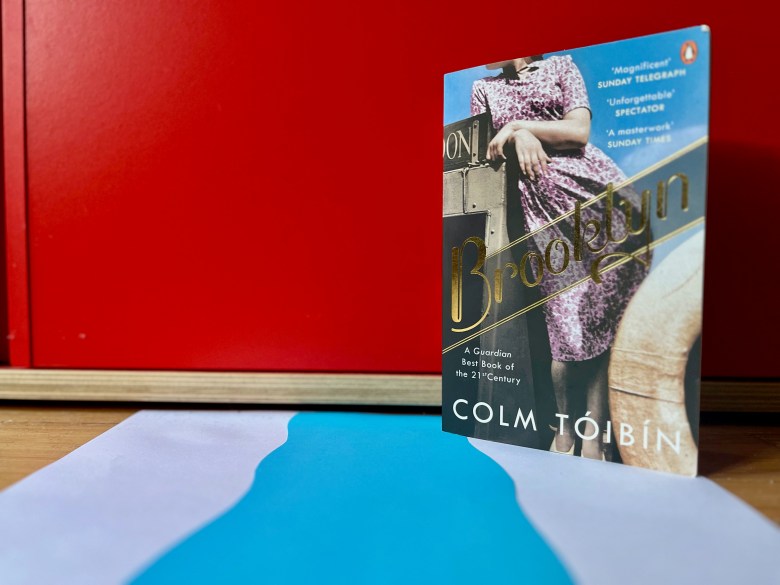
In the end, we don’t quite know what Eilis does. We know she breaks up with her Irish boyfriend by leaving a note at his door, and that she is planning to go back to Brooklyn, but we don’t know whether she actually boards the ferry, and we don’t know whether she’ll arrive and what will happen with Tony.
I guess, in the end we never know what might happen. I do know that I have lately been quite preoccupied with books about leaving and about characters feeling quite unhappy. Things have changed considerably, though, and I don’t want to leave anymore. Thankfully, I can still read about it.
What did you think of Brooklyn? Have you read its sequel, Long Island, too? Where would you go if you wanted to start over? Do you think Eilis makes the right decision? Was it easier to start over back in the 1950s? Please let me know in the comments! Also, don’t forget to follow me for more book-related posts!
 The Open Book