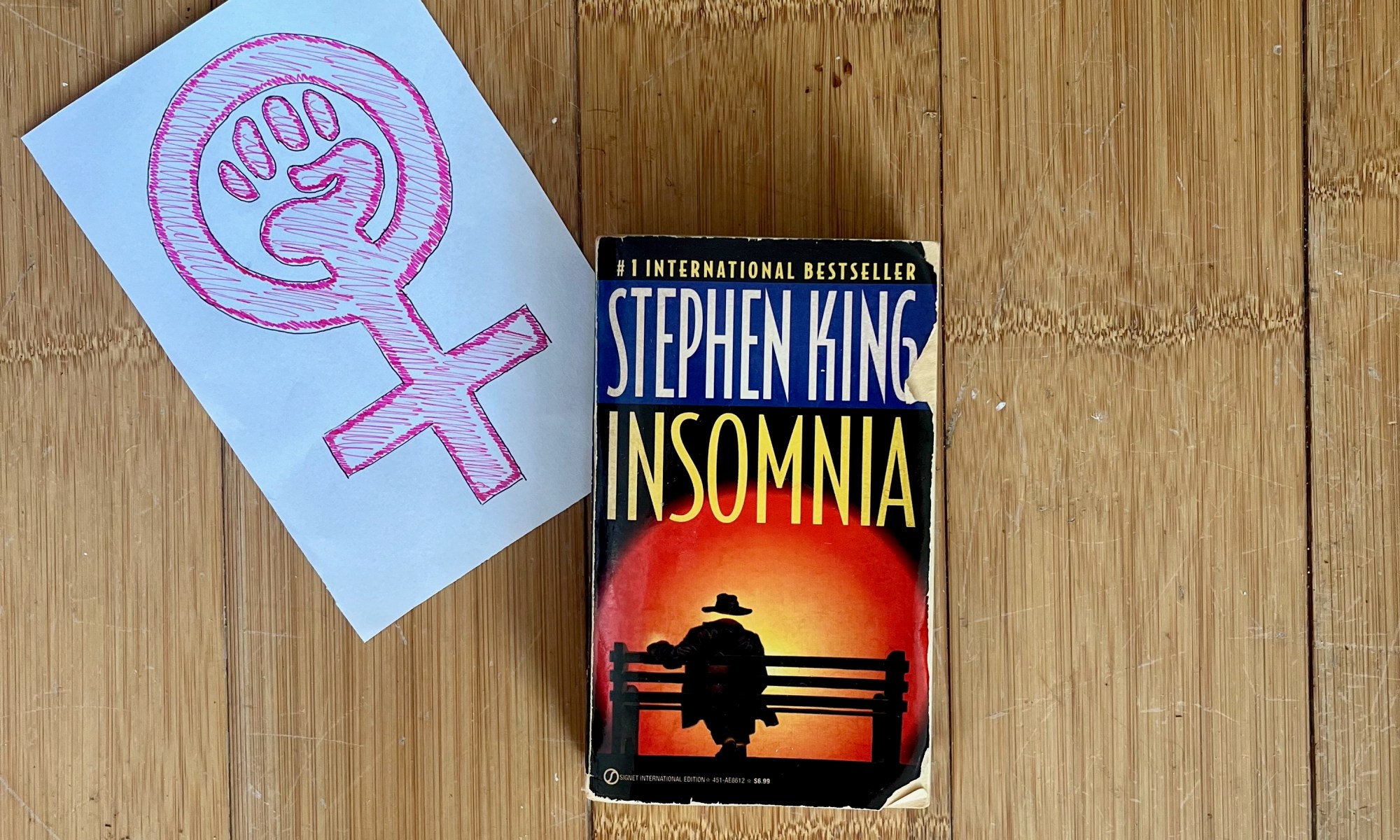

Did you know that back in the nineteenth-century, Gothic fiction was used as a way to comment on political issues without openly doing so? Vampires, for instance, might stand for those in charge taking all their subjects’ money, and awful, monstrous tyrants may represent abusers of power. It is a tradition that’s all but died out; even today, there are books that seem to be about one thing, but are in fact about something else entirely. So when I read Stephen King’s Insomnia lately (yes, him, again), I realised that this horror novel about a man who can’t fall asleep is about something much more political – and something much more relevant. Want to know what it is? Read on!

Insomnia is about a retired man, Ralph Roberts, who lives in Derry, Maine and keeps waking up earlier and earlier in the night. Eventually, he’s so tired that he starts seeing auras. At the same time, a controversial pro-choice feminist activist, Susan Day, is planning to give a speech in Derry, which is met with much protest from some of its citizens. Ralph finds out that something bad is going to happen at this event, and he and his neighbour Lois are the only one to avert disaster.
Whew, I think that must be the shortest summary of Insomnia ever. I omitted all sorts of supernatural elements, I got rid of references to other King novels (for there are plenty), and I neglected to mention the names of any other characters. That’s because in this blog post, none of these things really matter – not if you consider King’s novel a modern Gothic story, as its underlying message seems to be one in support of abortion.

In a previous blog post, I already mentioned how I might at one point write about why Stephen King might be a feminist. While reading Insomnia, I kept thinking how astute that observation was. Even though this novel was written over thirty years ago, abortion rights are a hotter topic than perhaps ever before. With the overturn of Roe vs Wade by the Supreme Court in 2022, abortion has become illegal in several states in the USA, and aiding someone in having an abortion is considered a crime in some places. It looks like many hard-earned women’s rights are rolled back, and sometimes, especially in the online world, it even feels like we’re slowly returning to a society which considers women inferior to men.
It should come as no surprise that nowhere in Insomnia King explicitly states that he supports abortion. Furthermore, I know I should tread carefully here because the events and characters in a novel do not necessarily reflect the author’s opinion. Still, despite the action-packed plot filled to the brim with blood and gore and supernatural beings and burning houses and suicide missions and the tragical end (spoiler alert!) of Susan Day, abortion, as well as other women’s rights issues such as domestic violence and women’s shelters, are presented in a nuanced way – which is not often the case in popular fiction.

And King is popular. When I did some research on this book and the feminist ideas I thought were represented in Insomnia, it took me no time at all to find plenty of Reddit posts, book blogs and Instagram videos that all shared their views on this topic. Clearly, I was not the first. Some argued that Stephen King often spends too much time on his female characters’ appearances to be taken seriously as a real feminist (and I must admit that I have at times been bothered by his detailed descriptions of breasts and the way his female characters are sexualised much more than the male ones). Others claimed that the novel’s climactic pro-choice event is only used as a backdrop for the real story. Then again, there were some that said that overall, considering the fact that King is a white man in his seventies, his books are quite inclusive and contain some very strong female characters. Clearly, King’s readers are divided on this issue.
As for me, I like to think that it was not an accident that King decided to include abortion in Insomnia; to me, it was the most important part of the book, and the reason I started this blog post with Gothic novels. I also like to think that Stephen King is very aware of the old tradition of criticising society by writing scary stories (something he also did in The Dead Zone, one of his earlier novels which eerily predicted the rise of Trump), and Insomnia is a perfect example of this. Let us, therefore, consider it a feminist novel.
Speaking of feminism, here’s one more thing before you leave. I am well aware that the people most suited to write about feminist issues are, obviously, women. I am also aware that it has been quite a while since I last discussed a novel written by a woman (three months ago, to be precise).
It’s high time I write a blog post about a book that wasn’t written by a man. I’ve just finished Mary Shelley’s Frankenstein (it’s not a coincidence that I am comparing Stephen King to Gothic fiction) and am currently reading Anne Eekhout’s Mary, which is a fictionalised account of the events that inspired the former author to write her most famous novel. I am quite sure my next post will be about a book written by a woman. However, considering the world we live in now, with feminism rolling back a decade or five, I don’t really mind that men write about feminist issues.
These dark days, we need all the help we can get.
What did you think of Insomnia? Do you think it’s a feminist novel, or are the feminist issues just the backdrop for the ‘real’ story? Can you think of any examples of (horror) novels that subtly comment on society? Do you think Stephen King is a feminist? Are there any other books that discuss abortion? Please let me know in the comments! Also, don’t forget to follow me for more book-related posts!
 The Open Book