
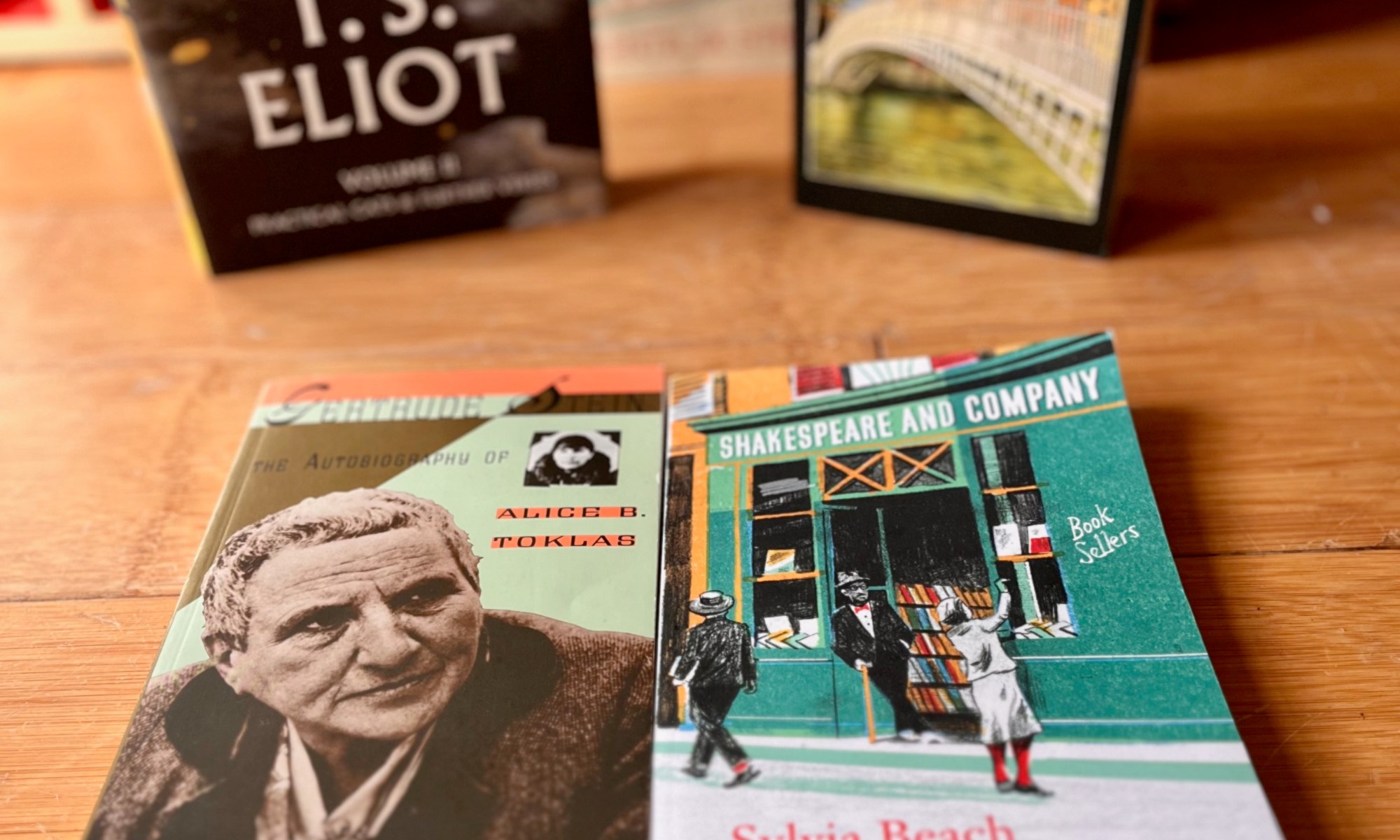

If I had been alive in the 1920s, I would have gone to Paris. Everyone lived there; so many famous painters, musicians, writers, and they all flocked together on the so-called Left Bank, that part below the river Seine. When I was in Paris last week, I read two books by two American women whose influence on these artists cannot be understated. Want to know who they were and what they did? Read on!

If I had lived in Paris in the 1920s, I would have gone to 27 Rue de Fleurus, near the Jardin de Luxembourg. For that’s where Gertrude Stein, a poet, art collector, novelist and critic, lived. Her The Autobiography of Alice B. Toklas is very much a literary experiment, and it narrates Stein’s life in Paris from the point of view of her partner Alice B. Toklas. Gertrude Stein was known for her trademark modernist style, and this book is no exception. I loved how Stein continuously had Toklas think of Stein as a genius, and write about how all modern writers copied Stein; it added a sense of ironic grandiosity to it. (Though I have read here and there that Stein really felt that way about herself.) I would have travelled there and tried very hard to be invited to her gatherings, and would have made sure to stick around.
If I had lived in Paris in the 1920s, I would have gone to 12 rue de l’Odeon, near the Jardin de Luxembourgh, where Sylvia Beach set up a very influential bookshop. I read all about it in her memoir Shakespeare and Company, which is what she called her shop. This memoir is much more down to earth, and Beach seems much more aware of the exceptional creativity of the people who flocked to her bookshop, instead of focusing on her importance within it. I think people would have been able to find me in that bookshop every single day.
If I had lived in Paris in the 1920s, I would have gone to Stein’s portrait viewings of Picasso and Matisse, among others. I would have read her literary portraits of those painters. I would have bought the books she published for in her own house under the name of Plain Editions.
If I had lived in Paris in the 1920s, I would have gone to the launch party of James Joyce’s Ulysses at Shakespeare and Company, because Sylvia Beach was the only person brave enough to publish a book that was banned in several countries. It cost her an arm and a leg, but Ulysses is now considered one of the most important books of the twentieth century.
If I had lived in Paris in the 1920s, I would have gone to Jardin de Luxembourg, for that beautiful park is located very near both Gertrude Stein and Alice B. Toklas’s house, as well as Shakespeare and Company. If I had not invited to Stein’s dinner parties, or if the bookshop would had been closed, I would just have walked around in that garden. I bet Pablo Picasso was there all the time, or Ernest Hemingway, or poets Ezra Pound and T. S. Eliot, or Ford Madox Ford, or F. Scott Fitzgerald. I don’t think I would actually have been brave enough to talk to them, but I would just sit on a conveniently located bench and observe them. One of them might even have written a story about me, that weird woman who would always be watching them.
Even if I had lived in Paris in the 1920s, I would have noticed how all those artists mentioned in the previous paragraph were men. And that’s not entirely fair, because according to both Gertrude Stein and Sylvia Beach there were plenty of talented women who deserved the spotlight (although apparently, Stein had Toklas take care of her artists’ wives so Stein could talk to the men without being interrupted). Take for instance Bryher, an English novelist (I looked her up on the internet and managed to buy two of her out-of-print novels), or her lover Hilda Doolittle, whose pen name was H.D., or Djuna Barnes, an American writer, or poet Mila Loy. I would have celebrated all these women and bought their books the moment they were published.
If I had lived in Paris in the 1920s, I would have realised, perhaps even more than now, that Gertrude Stein and Sylvia Beach were very important for all the artists that flocked to the Left Bank in Paris. If it were not for Stein, Picasso might not have become so famous. If it were not for Beach, James Joyce might never have found a publisher for Ulysses. If it were not for those two women, the world might have been very different.

When I was in Paris last week and walked past Gertrude Stein’s address or the old location of Shakespeare and Company (there’s another bookshop in Paris with the same name, and it was named after Beach’s), I felt such in awe of these two women and everything they did back then. I so wished I could travel back in time. I wished I could tell these women how much I admire them, and how much I wish more people would still remember them.
If I had been alive in the 1920s, I would have gone to Paris and would never have left. However, since this is obviously impossible, I’m glad I went there last week and visited the places where Gertrude Stein and Sylvia Beach lived. I’m sure some part of me travelled back in time and nodded and smiled at them, and made clear that they would not be forgotten.
Have you ever been to Paris? What would you visit in Paris if you were there? Which era would you travel to, if you had a time machine? Have you ever read anything by Gertrude Stein, or heard of Sylvia Beach? Which female writers do you think are unjustly forgotten by history? Please let me know in the comments! Also, don’t forget to follow me for more book-related posts!
(P.S.: If my wish to live in Paris in the 1920s were denied, then I would try living in the 1980s in England. That’s because there’s one more thing I need to share about men being remembered instead of women: I read an anecdote in Shakespeare and Company by painter André Gide, who pranked his concierge when he was young. She had a small turtle, and without her noticing, they kept exchanging it for a larger one. If I had been alive in the 1980s, I would have asked Roald Dahl whether reading this passage in Sylvia Beach’s book inspired him to write his lovely story Esio Trot. I doubt he’d ever admit it.)
 The Open Book