

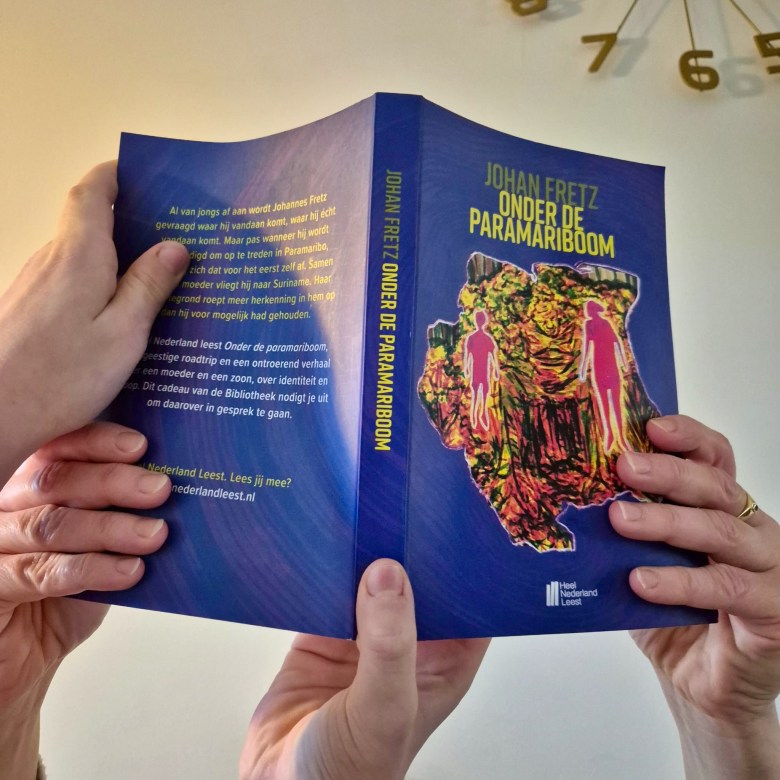
Every year, there’s a Dutch organisation that publishes a book which is available for free for everyone. This year’s book is Onder de Paramariboom by Johan Fretz, about a young man who travels to Suriname in order to find out more about his mother’s native country. The organisation giving away all these free books hopes that we will discuss these books together. I started a book club dedicated to it, which consisted of, well, just me. Want to know what that was like? Read on!
Book club leader Elke: Before we start talking about the book, I’d like to give a short summary. Onder de Paramariboom is about Johan Fretz (the protagonist shares his name with the novel’s author), a young man of mixed heritage. His father is German, and his mother is from Suriname. Johan has always been adamant he is just a normal Dutch man, but only when he’s been in Suriname for a couple of days does he begin to realise that there’s always been suppressing a part of him. So, what did you think of this book?
Bookworm Elke: I just loved how every person living in the Netherlands could get a free book, after which we can all talk about it to each other.
Literary analyst Elke: Definitely! We could talk about the many themes of this book, such as racism, heritage, identity, colonialism, colours, connection, or self acceptance. Or you can talk about the title (Under the Paramaribo Tree; the original title is a portmanteau of the capital city of Suriname and the Dutch word for tree), or about why it’s a novel, even though it’s probably based on Johan Fretz’s own experiences. Why do you think he decided to play around with this notion?
Woke Elke: I think it’s easier to discuss big topics this way. And did you notice that many of these themes overlap? It’s about how Johan has always sort of ignored his Suriname roots, because he was afraid he’d be discriminated against. And it still happened, because his skin is darker than those of White Dutch people. I think many White people, including myself, have no idea how hard it can be not to look like the others.
Blogger Elke: And that’s why I’m so happy that this book was selected for the free book event. My blogs are always about how a specific book has taught me something, be it about myself, the world, history, or whatever. This book acquainted me with someone with Surinamese heritage.
Woke Elke: Well, about time. You’re like one of these people mentioned in the book, these high-brow, often academic persons who talk about the importance of inclusivity while they’re all White and live in their little White Bubbles.
Book club leader Elke: Thank you. Before we start insulting each other, bear in mind that everyone can be themselves here. We all represent a part of Elke, and we’re all equals.
Woman Elke: Thanks. Indeed, we are all equals here. I noticed that there’s quite a few well-written women in Fretz’s novel, such as Virginia, Johan’s mother. She has been through a lot since she arrived in the Netherlands when she was nineteen years old. She has been a major influence on Johan, but they only truly understand each other when they’re in Suriname together.
Feminist Elke: Yes, his mother’s conflict is very touchingly written. But Jaantje? She is White, pretty, has long blonde hair, and of course Johan falls desperately in love with her. With her appearance, obviously, that Western Europe beauty standard. Urgh. Why couldn’t he have fallen in love with a woman with short hair?
Book club leader Elke: Or we interpret it as human connection; two characters, both not in their native country, both so-called half bloods, find each other. Please don’t start a rant on how short hair can also be beautiful. That’s a topic for another book.
Blogger Elke: Great idea. I’ll take a quick look at all my books and blogs and find out whether I can write about this soon.
Woke Elke: Let’s return to that “half-blood” which you so casually mentioned earlier. According to Johan’s mother, half-blood meant you were only half a person, because only the “white blood” counted. We really shouldn’t use that anymore. Virginia suggests using double blood. I like that.
Literary analyst Elke: Yes, I was really touched by that. And that doubleness is also apparent between Johan and his mother, who travels to Suriname a couple of days later. He discovers so much about the country and himself, but only when they’re together do they fully understand each other.
Music-obsessed Elke: Yes, and the moment that happens is wonderful. When they’re at Virginia’s sister’s house, they decide to sing a couple of songs. They first sing Simon and Garfunkel’s The Sound of Silence, because Virginia loves it, but then they start singing Mississippi Goddam by Nina Simone. It’s not a coincidence that they initially pick a song by two White men, but then decide to sing a protest song by a Black singer.
Literary analyst Elke: And it’s also very interesting to see how Fretz keeps using references to both White and Black people. I knew a couple of them, but it was great to look up all those other references I didn’t know. It also illustrates that Johan doesn’t belong to White or Black people, but to both.
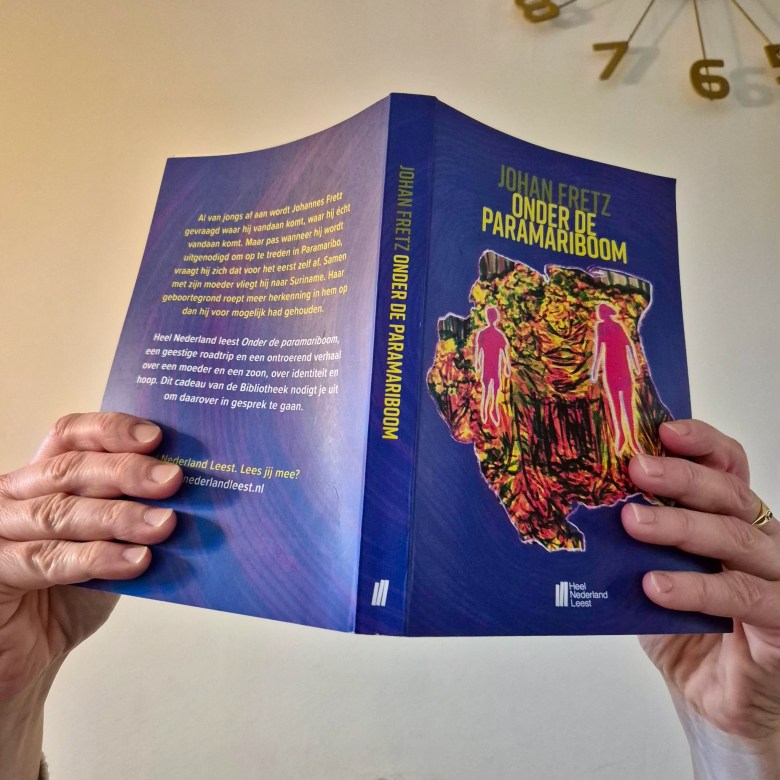
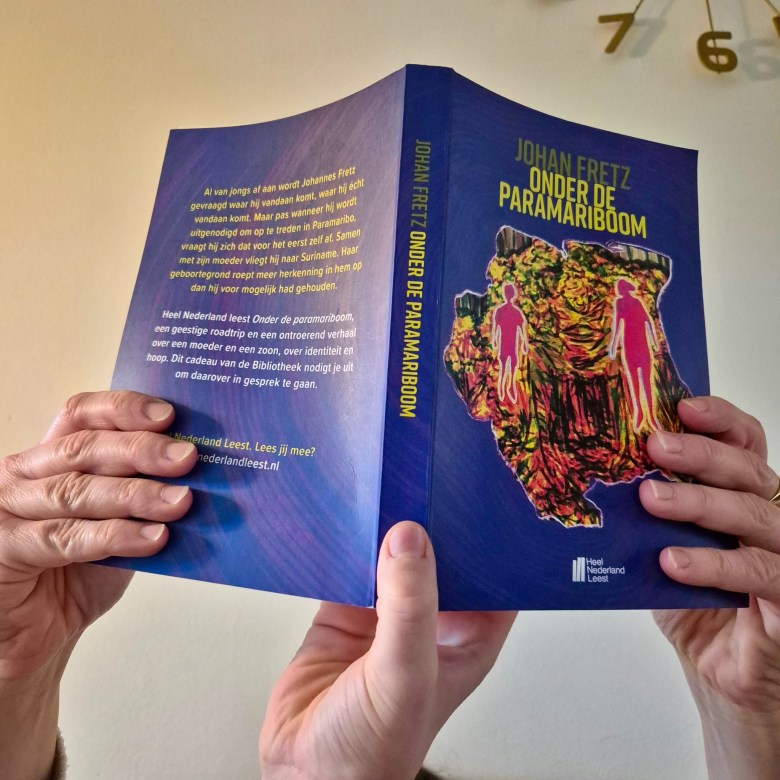
Book club leader Elke: Yes, that’s true. And Johan accepts himself more and more. Speaking of acceptance, let’s discuss the book’s cover. We see two people in from of a map of Suriname. I think it’s Johan and his mother.
Newspaper-reading Elke: Finally, someone mentions the cover. There’s been a lot to do about it, because the outline of Suriname on the cover was based on borders drawn up by the United Nations, but they’re quite controversial.
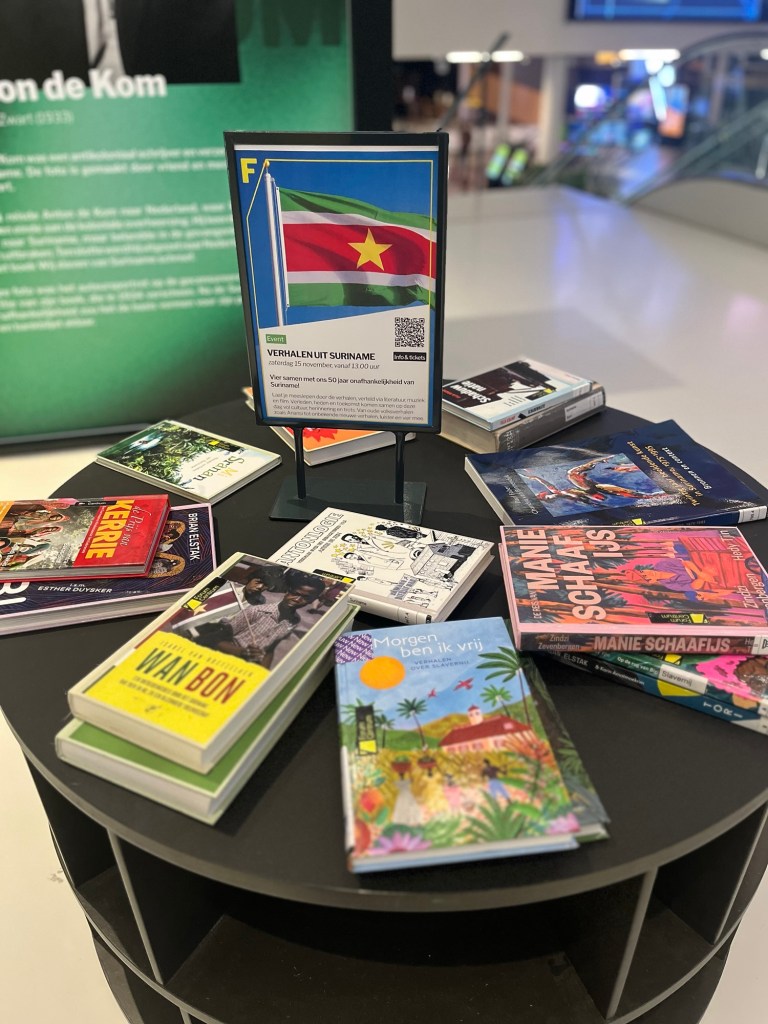
Politically aware Elke: All of this while Suriname celebrates its fiftieth year of independence this year – on the 25th of November, in fact. This is why I like the selection of this book even more, because it means Suriname is a proud country. When Johan is in Suriname, it’s almost election time. However, nobody wants to talk about it.
Book club leader Elke: No, that’s right, it was so awful to read. Especially because Desi Bouterse was mentioned often, who, in 2015 when the story takes place, won these elections.
Newspaper-reading Elke: He died recently, a year after he’d been convicted for his role in the December Murders in 1982. I remember it was all over the news here. Onder de Paramariboom was first published in 2018, however, so this last bit wasn’t included in it.
Literary analyst Elke: That’s right. It does show that, even though it’s a feel-good novel, there are still some issues that rage just below the surface, both related to Johan and the country itself. But the more you read, the more Johan’s internal struggles are solved.
Book club leader Elke: Do you think the mean idea of this novel is human connection?
Literary analyst Elke: Or any form of connection, really. Especially in all of those themes you can find in this novel.
Music-obsessed Elke: No way, it’s about how all these references to Black and White music, as well as movies and books, eventually blend together.
Feminist Elke: Yes, I do like that. However, it’s a pity that the main character is a man, and not a woman.
Newspaper-reading Elke: You did say that some women are really well written, though, so please don’t start again.
Woman Elke: That was me. Honestly, we’re not the same person.
Feminist Elke: Look at what’s happening here! Really?
Newspaper-reading Elke: Sorry. But I wanted to talk about the cover again – which, coincidentally, both Elkes, features a woman as well as a man.
Politically aware Elke: Cover schmover. The designer said that he didn’t mean to cause anyone any harm and apologised. That’s it. But I do think the political situation in Suriname deserves more attention.
Woke Elke: Well, nobody wants to talk about it in the book, so we don’t have to either. No, it’s about how everyone can be themselves. We haven’t even talked about the meaning of the title yet, but it’s about how Johan imagined Suriname when he was younger. So the main idea of this novel is definitely inclusivity.
Newspaper-reading Elke: No! It’s Suriname’s independence!
Politically aware Elke: No! It’s the elections!
Feminist and woman Elke: No! It’s the women presented in the novel!
Music-obsessed Elke: No! It’s the music!
Literary analyst Elke: Not at all! Please just read the book carefully!
Book club leader Elke: Oh, this is just wonderful. I mention human connection and that’s when you decide to start a fight. I just meant to say that everything comes together in the end, and that everything is connected.
All Elkes: Oh, right. Just like all our unique characteristics ensure a full analysis.
Book club leader Elke: Yes, just like how Johan eventually accepts all aspects of himself when he finally understands where he comes from. His own context, so to say. If that’s not human connection, then I don’t know what is.
Bookworm Elke: And then there’s another form of human connection, when everyone in the Netherlands has read this book and talks to others about it. That way, we’ll all come closer as a people.
Book club leader Elke: Let’s hope that will happen. Thank you, all of you. So, who’s taken notes of this meeting?
Blogger Elke: What did you think of Onder de Paramariboom? What was the most important theme? What did you think of the way Johan discovered Suriname? What did you think of his family members, both his Surinamese mother and his German father (who always denies he’s German)? Did I forget other important issues raised in this novel? Please let me know in the comments and keep the conversation going!
 The Open Book