

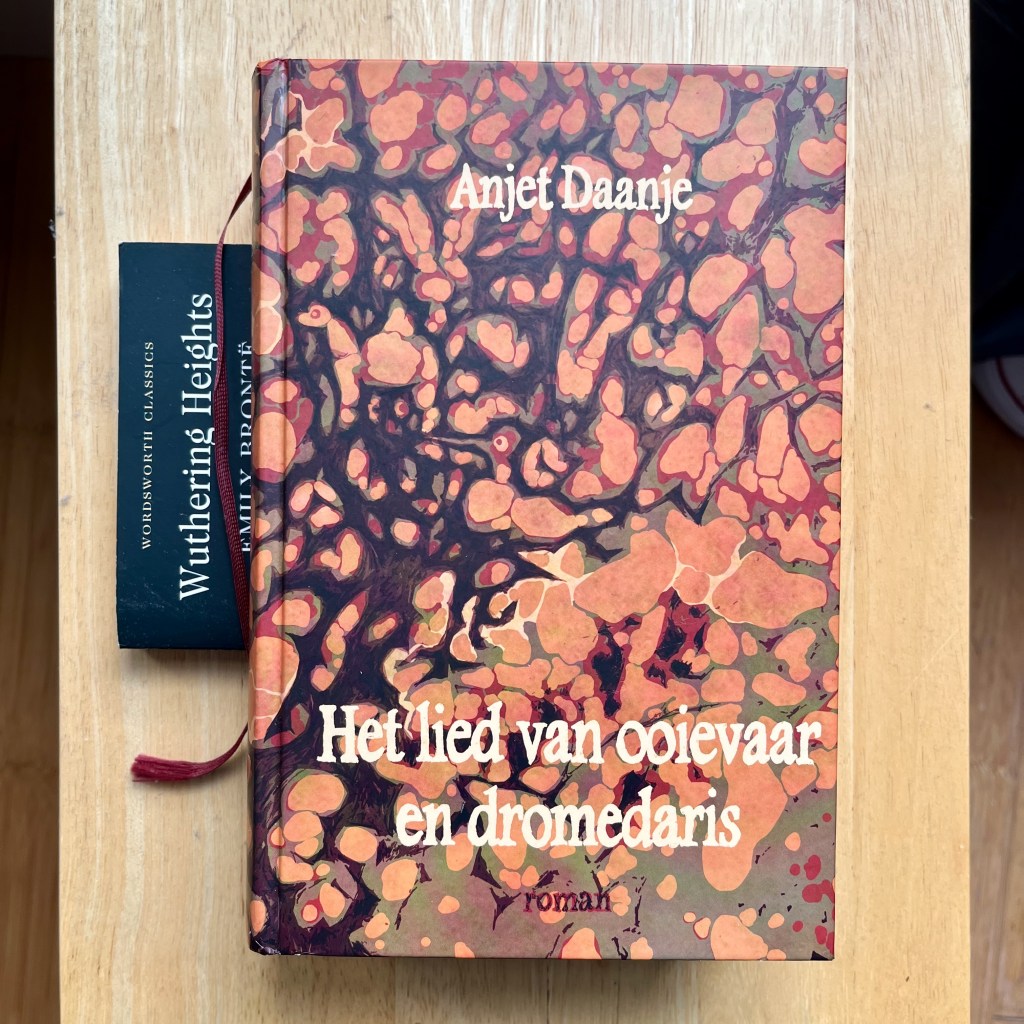
There’s fangirls and there’s fangirls. Whenever I really like a book, I write a blog post about it. I tell my (hopefully) captive (tiny) audience all about it, and write down what I’ve learned from it. Sometimes a book changes my life, and I tell everyone. I think I’m a proper fangirl. Well, when I read Anjet Daanje’s novel Het lied van ooievaar en dromedaris, which is a novel based on Emily Brontë and her only novel Wuthering Heights, I realized that she is the Queen of Fangirls. Want to know why? Read on!
Het lied van ooievaar en dromedaris (‘the song of stork and dromedary’) is not about one event. Rather, it is about how the life of one famous but mysterious nineteenth-century English writer has inspired the lives of others over the course of two hundred years. The novel consists of eleven stories, the first one starting right after Eliza May Drayden, the writer, has died, and the last one ending in our own time. Each story is inspired by either the life of Emily Brontë, or by her only novel, Wuthering Heights.

We hardly know anything about Emily Brontë, apart from some small pieces of knowledge that have been passed on by history, such as her passion for nature, her shyness, and that she was from Yorkshire. And then there’s the strange details: she always carried a tiny notebook with her, she may have talked to animals, and she may or may not have been photographed with her sisters. That’s about it. So how on earth, I wondered, could Daanje possibly write a novel inspired by Brontë?
Leave it to the fangirl. She used the scarce details we have about Emily Brontë and used them in each of the stories and each of the characters she penned up for her massive (over 600 pages) novel. There’s a translation of Brontë poems, there’s made-up letters from Millicent to her best friend (based on actual letters Charlotte, one of the other Brontë sisters sent to her best friend), there’s the ghost of Eliza May who haunts people over the years, just like Catherine haunts Heathcliff in Wuthering Heights. It’s like Daanje wanted to feel like she was another one of the Brontë siblings, by breathing new life into her.
The most important themes in Emily Brontë’s poems are Death and Time. Likewise, these are the most important themes in Het lied. To me, it feels like Daanje wanted to make clear that even though the woman who inspired her novel has died over a hundred and fifty years ago, her legacy has all but faded. There are still fans all over the world who visit the village the Brontë sisters grew up in, their novels are still required reading at schools, and there’s plenty of literary courses at university which discuss the Brontë novels extensively. True art, apparently, never dies – even if we hardly know anything about the person who created it. And Daanje wrote a novel about her.

There’s always something exciting about the mysterious. For Het lied, like all good novels, feels completely credible; we, the readers, are presented with a true account – or so it seems – of who Emily Brontë was; what she did all day and what she was like after her best friend, her sister Anne, died. And it is an account of how real people – or so we’re supposed to think – continue to be inspired by her life, her death, and her work. There are eleven stories, from mid-nineteenthcentury England all the way to twenty-first century Groningen, and all of them feel like not a second has passed since Brontë/Drayden died. All characters were made up, but I felt like they were real, every single one of them. I wanted them to be real. I wanted to feel close to Emily Brontë.
It took me a week to finish the six hundred forty-seven pages of Daanje’s novel. Straight after I had read the final page, I dived into Wuthering Heights, which, I must admit, I had to read at university, but I didn’t feel like it. This time, I devoured it – actually, I’m still in the process of devouring it; I will finish it tonight. It’s a strange and mysterious novel, and I love it. It’s even stranger and more mysterious when you know something about Emily Brontë, even if it’s the made-up knowledge penned down by Daanje.
I think I’m a proper fangirl. But Daanje is still the Queen.
Have you read any Brontë novels? What do you think of Wuthering Heights? Do you ever feel like writing a novel inspired by your favourite author? Please let me know in the comments! Also, don’t forget to follow me for more book-related posts!
 The Open Book
Great review and I just finished the novel of Daanjer myself. I hope it gets translated in English!
LikeLiked by 1 person
Thank you! It is such a wonderful novel, isn’t it? I discussed it in a book club, and it felt like we could’ve talked about it for days! Also, I do believe they’re working on an English translation now. I bet the English-speaking world will love it!
LikeLike